
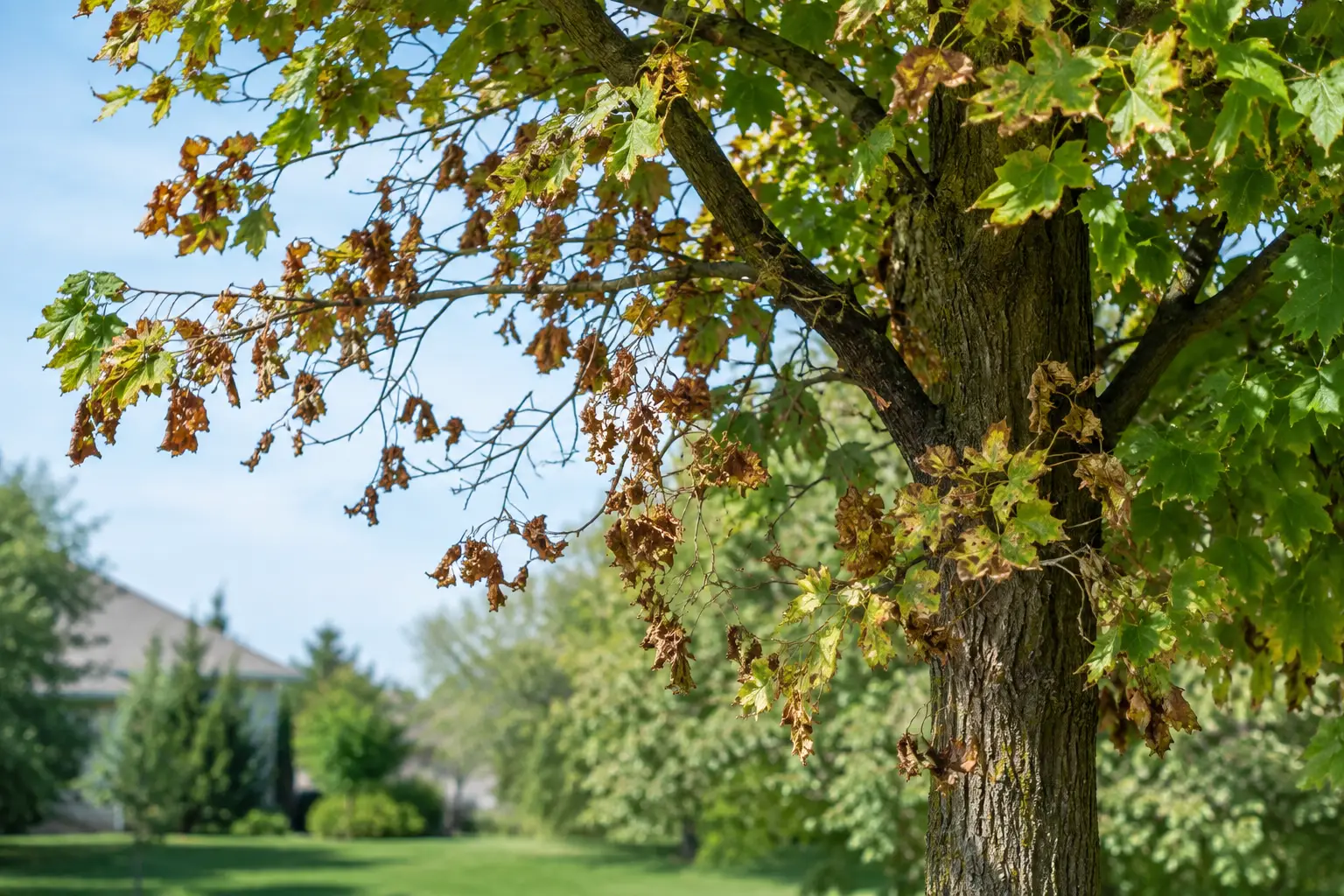
A mature tree can add shade, privacy, and real value to a property. But when it starts declining, it can quickly become a safety issue for your home, tenants, customers, vehicles, and neighboring properties. Knowing the top signs of unhealthy trees helps you deal with trouble before a heavy rain, windstorm, or falling branch turns a manageable job into an emergency.
Some tree problems are seasonal or cosmetic. Others point to decay, disease, root damage, or structural failure. The difference matters. A professional assessment is the right call whenever there is a risk to people or property.
Top Signs of Unhealthy Trees to Watch For
A tree does not need to be completely dead to be dangerous. In fact, many of the highest-risk trees still have green leaves and appear healthy from a distance. Walk your property regularly, especially after storms, construction work, flooding, or long dry periods, and look closely at the trunk, branches, roots, and canopy.
Dead, broken, or hanging branches
Dead branches are one of the clearest warning signs. They may have no leaves during the growing season, brittle bark, bare twigs, or a gray, dry appearance. Broken limbs caught in the canopy are also a problem. They can drop without much warning, particularly during wind or heavy rain.
A few small dead twigs are normal on many mature trees. Large dead limbs, several dead branches in one area, or branches hanging over roofs, driveways, sidewalks, play areas, and parking spaces need attention. Pruning can often remove isolated deadwood safely, but widespread dieback may signal a larger health issue.
Cracks, splits, and weak branch unions
Look for long cracks in the trunk, splits where major limbs meet, or branches that form a tight V-shaped junction with bark pressed between them. These weak connections can fail under snow, wind, or the weight of wet foliage.
Not every crack means a tree must come down. A small surface crack may be stable, while a deep crack through a major trunk section can be serious. Location changes the urgency. A questionable limb over an unused corner of a yard is different from one over a busy strata walkway or commercial entrance.
Peeling bark, cavities, and visible decay
Bark damage can happen for many reasons, including weather, lawn equipment, pests, and disease. What matters is the pattern and severity. Large areas of loose or missing bark, soft wood, deep cavities, and hollow sections can indicate internal decay.
Trees can survive with some hollowing, since the outer layers carry much of the tree’s water and nutrients. Still, decay reduces structural strength. If a cavity is large, located near the base, or paired with leaning, cracking, or dead branches, it should be assessed promptly.
Mushrooms or fungal growth near the base
Mushrooms growing from the trunk, roots, or soil around the base can be a sign that fungi are breaking down wood below the surface. This does not automatically mean the tree is about to fall. Some fungi live on dead material nearby rather than in the tree itself.
However, shelf-like fungi attached directly to the trunk, repeated mushroom growth at the root flare, or fungal growth combined with thinning leaves and branch dieback deserves a closer look. Root and trunk decay are easy to miss until the tree becomes unstable.
A sudden lean or shifting soil around roots
A tree that has always grown at a slight angle may be perfectly stable. A new lean is different. If the tree appears to have shifted after a storm, excavation, flooding, or soil saturation, treat it as a priority.
Check for raised soil on one side of the root area, cracks in the ground, exposed roots, or a gap where the trunk meets the soil. These can mean the root plate is moving. Keep people, vehicles, and equipment out of the area until the tree can be inspected.
Thinning leaves, early leaf drop, or uneven growth
A healthy tree should generally leaf out evenly for its species and season. Sparse foliage, leaves that are smaller than usual, early color change, early leaf drop, or bare sections high in the canopy can point to stress.
The cause may be drought, compacted soil, insect damage, disease, root loss, or damage from nearby construction. One bad season does not always mean a tree is failing. But if the same symptoms return year after year, or one side of the tree declines much faster than the other, it is worth investigating.
Root damage and poor growing conditions
Roots are often the hidden part of the problem. Cutting roots for a driveway, trench, retaining wall, or building project can affect a tree months or years later. Soil piled against the trunk, repeated vehicle traffic over the root zone, poor drainage, and compacted soil can also weaken a tree over time.
Watch for girdling roots, which wrap around the base of the trunk and restrict water and nutrient flow. Root damage can also show up as canopy decline, a lean, or sudden branch failure. Avoid digging or adding fill close to mature trees without considering the root area first.
When Tree Problems Become a Safety Concern
The most urgent situations involve a compromised tree or branch near a target. Targets include homes, garages, fences, power lines, sidewalks, roadways, parked cars, playgrounds, and places where people gather.
Call for professional help quickly if a tree has a fresh lean, a split trunk, large hanging limbs, exposed roots, storm damage, or a major dead branch over an occupied area. Do not try to pull down a hanging limb, climb the tree, or cut large branches from a ladder. The risk goes up fast when wood is cracked, under tension, or close to utility lines.
Power lines require special care. Keep clear of any branch touching or close to a line, and contact the utility provider or a qualified tree professional. Never attempt to trim around electrical equipment yourself.
What You Can Do Before Calling for Service
You do not need to diagnose the exact disease before requesting help. Clear photos of the full tree, the damaged area, the base of the trunk, and anything beneath the tree can help explain the situation. Note when you first saw the problem and whether it worsened after weather, construction, or landscaping work.
Keep the area clear if there is an obvious hazard. Move vehicles away from the drop zone and keep children, pets, residents, and visitors out from under damaged limbs. For commercial and strata properties, mark off the area if possible and let occupants know about the temporary risk.
Routine care also prevents many avoidable problems. Proper pruning removes dead or rubbing branches before they fail. Mulch can protect roots when kept away from the trunk, while sensible watering helps trees through dry periods. Avoid topping trees, which leaves large wounds and encourages weak, fast-growing shoots.
Pruning, Treatment, or Removal: It Depends
Not every unhealthy tree needs removal. A tree with a few dead limbs may only need targeted pruning. A stressed tree may recover after better watering, soil care, pest treatment, or removal of competing brush and overgrowth. On the other hand, a tree with severe decay, a failing root system, or major structural defects near a building may be safer to remove.
The best decision depends on the tree species, age, location, defects, and the consequences if it fails. This is especially true on strata and commercial sites, where one neglected tree can create a larger liability and disrupt access for residents, tenants, or customers.
For property owners across the Fraser Valley, Hometown Landscaping Near Me can help with practical tree trimming, removal, brush clearing, and cleanup work. The goal is straightforward: deal with the hazard, clean up the mess, and leave the property safer and easier to maintain.
A tree problem rarely improves by being ignored. If you see deadwood, decay, a new lean, or branches threatening an active area, arrange an assessment while the work can be planned safely and on your schedule.
Leave a Reply